
Enterprise agility has evolved far beyond the adoption of Agile frameworks. Today’s organizations face a world characterized by rapid technological disruption, shifting customer expectations, geopolitical uncertainty, and the accelerating influence of artificial intelligence. In this environment, agility is no longer about delivering software faster, it’s about creating organizations that can continuously adapt, learn, and deliver value regardless of what changes next.
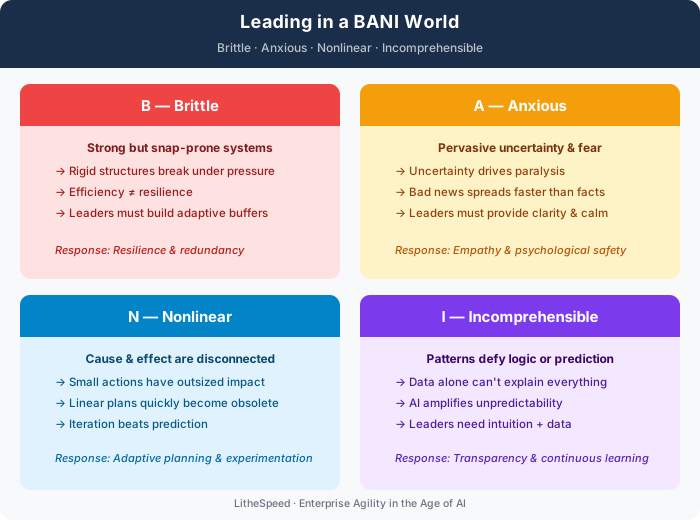
This challenge is at the heart of Leadership in Flux, the podcast hosted by LitheSpeed Founder and CEO Sanjiv Augustine. The podcast explores what leadership looks like in a BANI world, one that is brittle, anxious, nonlinear, and often incomprehensible. Through conversations with executives, transformation leaders, and Agile pioneers, Augustine uncovers practical lessons for organizations seeking to build true enterprise agility.
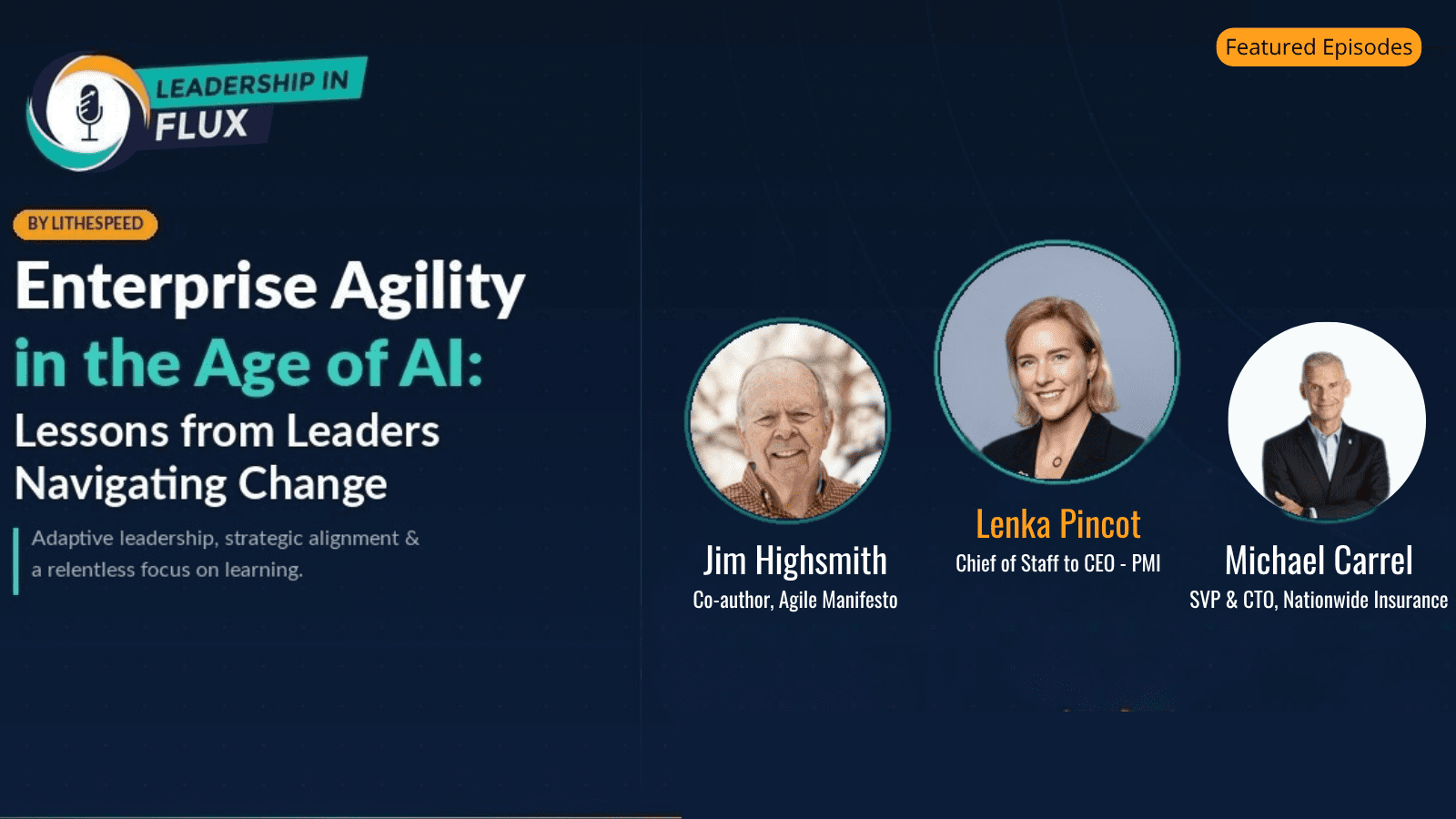
Three recent guests, Lenka Pincot, Michael Carrel, and Jim Highsmith, offer complementary perspectives on what it takes to thrive amid uncertainty. Their collective insights reveal that enterprise agility is ultimately about adaptive leadership, strategic alignment, and a relentless focus on learning.
Enterprise Agility Starts with Leadership
Many Agile transformations begin with processes and frameworks. Successful enterprise agility transformations begin with leadership.
In his conversation with Lenka Pincot, PMI’s Chief of Staff to the CEO and executive transformation leader, Sanjiv explored the connection between organizational transformation and leadership alignment. Lenka’s role includes guiding enterprise-wide strategic initiatives, fostering innovation, and ensuring that execution r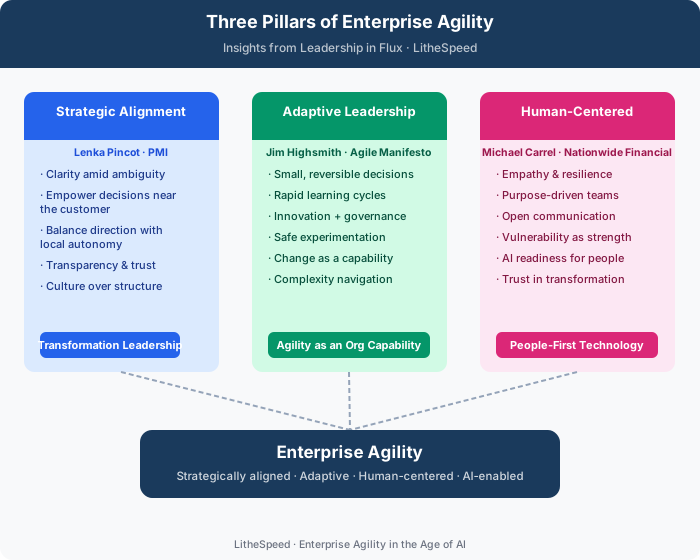 emains connected to organizational goals.
Lenka’s experience highlights one of the most important realities of enterprise agility: organizations cannot scale adaptability unless leaders model it first.
Transformation initiatives often struggle because leadership teams focus heavily on structure while underinvesting in culture. Enterprise agility requires leaders who can:
- Create clarity amid ambiguity
- Empower decision-making closer to the customer
- Encourage experimentation and learning
- Balance strategic direction with local autonomy
- Foster transparency and trust across organizational boundaries
Rather than treating change as a one-time initiative, agile leaders create systems that continuously adapt to evolving conditions.
From Project Thinking to Adaptive Operating Models
A recurring theme throughout Leadership in Flux is the shift away from traditional project-centric management toward more adaptive, value-focused operating models.
Enterprise agility requires organizations to rethink how work is funded, governed, and measured. Success is no longer defined solely by delivering projects on time and on budget. Instead, organizations must evaluate whether investments are producing meaningful customer and business outcomes.
This perspective aligns closely with LitheSpeed’s work helping organizations evolve from traditional PMOs toward Value Management Offices (VMOs)—structures that focus on value realization rather than activity tracking.
Adaptive organizations embrace:
- Outcome-based planning
- Continuous prioritization
- Cross-functional collaboration
- Faster feedback loops
- Data-driven decision making
The result is greater resilience and the ability to respond quickly when market conditions, customer needs, or technological opportunities change.
Learning from an Agile Pioneer: Jim Highsmith on Adaptive Leadership
Few individuals have shaped the Agile movement more profoundly than Jim Highsmith. As a co-author of the Agile Manifesto and one of the pioneers of adaptive leadership thinking, Jim has spent decades helping organizations navigate complexity.
In his conversation with Sanjiv, Jim reflects on the evolution of Agile and the challenges facing organizations today. While Agile practices have become mainstream, many organizations still struggle with the deeper organizational changes required to achieve true business agility.
Jim has long argued that leadership in complex environments cannot rely on prediction and control alone. Instead, leaders must cultivate adaptability, experimentation, and continuous learning.
This principle has become even more relevant in the AI era.
Artificial intelligence introduces unprecedented opportunities, but it also increases uncertainty. Leaders cannot always predict which technologies will succeed, how customer expectations will evolve, or how competitive landscapes will shift. Adaptive leadership provides the framework for responding effectively when certainty is impossible.
For enterprise leaders, this means:
- Making smaller, reversible decisions when uncertainty is high
- Investing in rapid learning cycles
- Encouraging innovation without sacrificing governance
- Creating environments where teams can safely experiment
- Viewing change as a capability rather than a disruption
As Jim’s work has emphasized for years, agility is not simply a methodology, it is an organizational capability.
Human-Centered Leadership in a Technology-Driven World
Technology may drive transformation, but people determine whether transformation succeeds.
This lesson is evident in Sanjiv’s conversation with Michael Carrel, Senior Vice President and Chief Technology Officer at Nationwide Financial. Carrel’s leadership philosophy emphasizes empathy, resilience, purpose, and passion as critical ingredients for organizational success.
While many discussions about enterprise agility focus on structures and processes, Michael reminds leaders that sustainable transformation depends on human connection.
Organizations undergoing significant change often experience uncertainty, fatigue, and resistance. Leaders who communicate openly, demonstrate vulnerability, and genuinely invest in their people build the trust necessary for successful transformation.
Human-centered leadership becomes especially important as organizations adopt AI and automation technologies.
Employees naturally wonder:
- How will my role change?
- What skills will I need?
- How will decisions be made?
- What remains uniquely human?
Enterprise agility requires leaders who address these questions directly while helping teams develop confidence and capability for the future.
Technology may accelerate work, but leadership creates engagement.
AI Is Changing the Rules, Agility Makes the Difference
Artificial intelligence is rapidly transforming how organizations discover opportunities, make decisions, and deliver value. Yet technology alone does not create competitive advantage.
Organizations that benefit most from AI share a common characteristic: they already possess the adaptability required to integrate new capabilities quickly.
Agile organizations are better positioned to:
- Experiment with emerging technologies
- Validate assumptions rapidly
- Integrate AI into existing workflows
- Learn from failures quickly
- Scale successful innovations efficiently
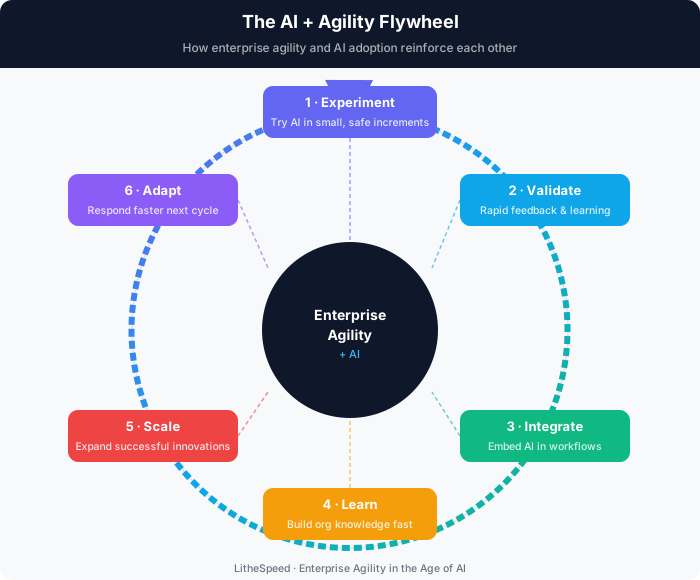
This is why enterprise agility and AI adoption are increasingly interconnected. AI demands organizational responsiveness, while agility provides the mechanisms to achieve it.
Leaders must balance innovation with governance, speed with responsibility, and experimentation with strategic alignment. The organizations that master this balance will be best positioned to thrive in the years ahead.
Building the Agile Enterprise of the Future
The conversations on Leadership in Flux reinforce a powerful message: enterprise agility is not a destination. It is an ongoing capability that organizations must continuously develop.
Lenka Pincot highlights the importance of strategic alignment and transformational leadership.
Jim Highsmith reminds us that adaptability is the defining leadership capability for complex environments.
Michael Carrel demonstrates that empathy and purpose remain essential leadership strengths even as technology accelerates change.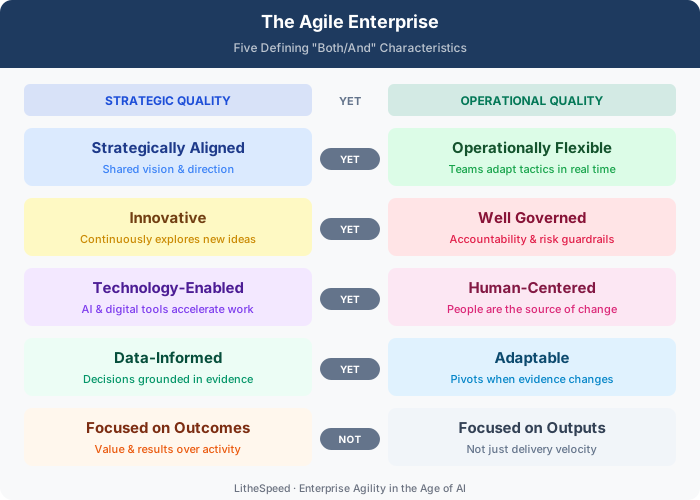
Together, their perspectives paint a compelling picture of the agile enterprise:
- Strategically aligned but operationally flexible
- Innovative yet governed
- Technology-enabled yet human-centered
- Data-informed yet adaptable
- Focused on outcomes rather than outputs
As organizations navigate the opportunities and uncertainties of the AI era, enterprise agility will become less of a competitive advantage and more of a business necessity.
The question is no longer whether change is coming. The question is whether your organization has developed the leadership, culture, and operating model required to adapt when it arrives.
Watch the featured Leadership in Flux episodes:
- Lenka Pincot: Leadership, transformation, and organizational alignment
- Michael Carrel: Human-centered leadership and resilience
- Jim Highsmith: Adaptive leadership and the future of enterprise agility
Explore more episodes of Leadership in Flux and discover how today’s leaders are thriving in a world of continuous change.